skip to main |
skip to sidebar
I know this book has been around for a year or two, but I'm just now getting around to reading it. I'm glad I did, because it took me to a new world, into the rarefied air of an Olympic gold medalist. I like a book that takes me someplace new. Here is a quote from Publisher's Weekly:
Keegan takes on death, religion, relationships and coming-of-age in her gorgeously stylized and irreverent debut about a rising Olympic swimming star. Not even a year after Philomena "Pip" Ash is born in 1960s Middle America, her parents put their rambunctious infant in a pool and watch the remarkable sight of a nine-month-old gliding through the water. With some help from Olympic Supercoach Ernest K. Mankovitz, Pip becomes a mercenary swimming machine who wins an unprecedented collection of gold medals in three Olympic games. Though Pip's connection with water is preternaturally intense, she can't relate to people, a dilemma heightened by early encounters with death and her innate awareness of loathsome pain and insecurities. After going through a premature career climax and the subsequent plummet, Pip is forced to deal with emotions she's spent her life ignoring; her sarcastic (and f-bomb laden) musings provide many amusing turns, while Keegan's linguistic playfulness moves the story at a fast clip, even if it sometimes muddles what's going on—particularly toward the end. This is worth reading for the prose alone.
Some of the language seemed a bit clipped and narcissistic at times, until the story moved along and I realized that Pip did try to do what she could. She had issues of her own to deal with and after all, the young ARE narcissistic. I imagine that is really the case with extreme athletes also, and compared to most, maybe Pip is just trying to do her best in life, as we all are. Something different and entertaining, for me anyway.


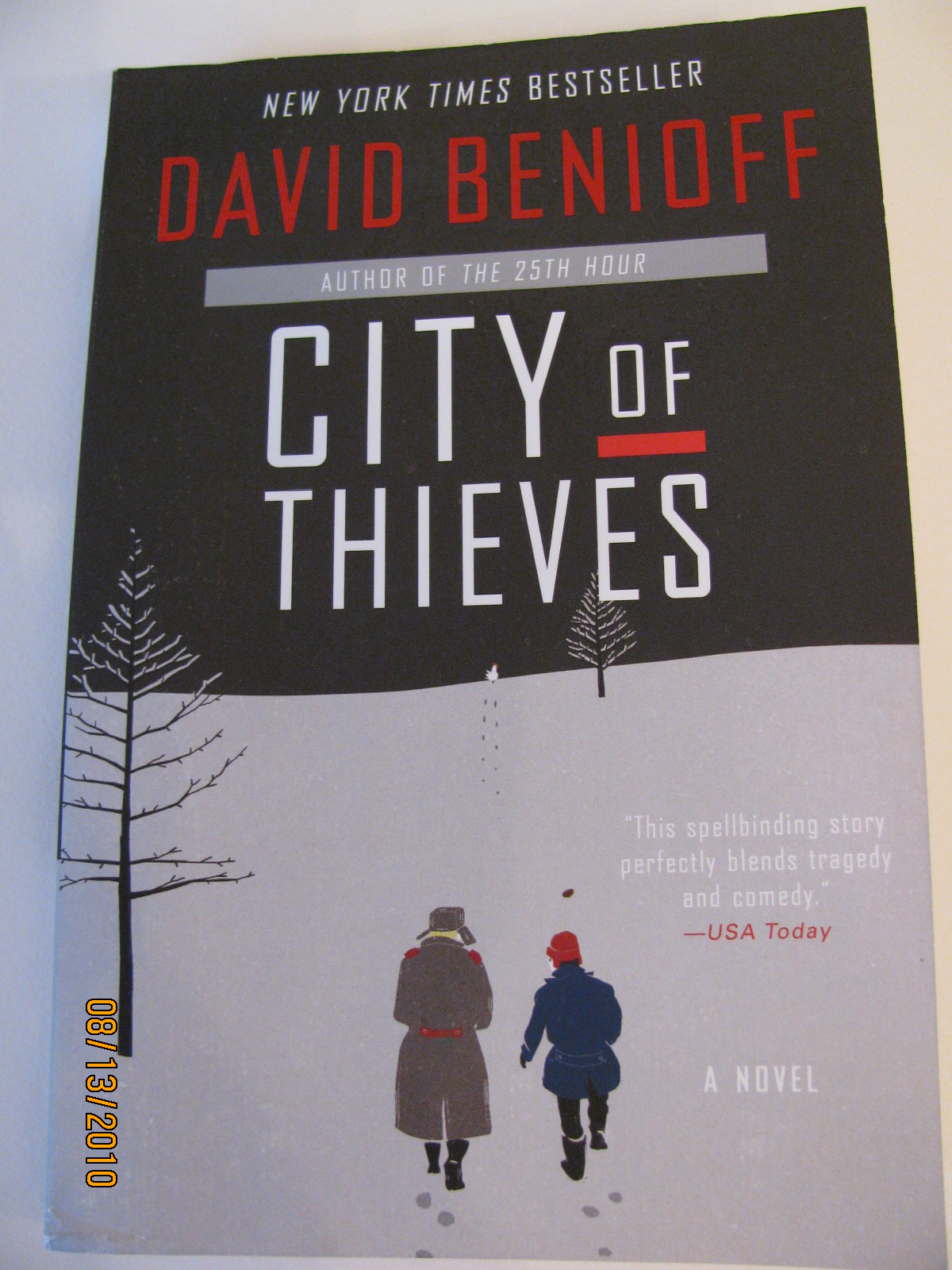
At only 258 pages, this is a great, quick read for both men and women alike. Set during the siege of Leningrad in 1942, this story revolves mainly around two young men, boys really. Lev is Jewish and so his existence is precarious at best. Kolya is blond, blue-eyed, with handsome Cossack features. Where Lev is introverted and shy, Kolya oozes confidence, and charms everyone around him.
Lev's father (a famous poet) has been "taken" by the secret police, and his mother and sister have fled the city. Like most teenage boys, Lev proudly stays behind to defend his home, and is the commander of his apartment building's volunteer fire brigade. One night on the roof, Lev and his friends see a downed paratrooper and rush to ransack the body. You see, they are all starving. Cannibalism is rampant (a true historical fact) and they are tearing apart books to boil down the bindings to eat the animal proteins in the glue. This confection is called "Library Candy" and it's hard to come by and very expensive. There are no dogs and cats left in the city. Lev is caught looting the paratrooper's body, and sent to a formidable and infamous prison known as The Crosses. There he meets Kolya, and the next morning, they are dragged before a high-ranking military officer who tells them they can go free on one condition. They must somehow procure one dozen eggs, to be used in a wedding cake for the Colonel's beautiful daughter. How they go about getting one dozen fragile eggs in the middle of a war, in the dead of a brutal Russian winter is the event-filled story. This author was a student of Ann Patchett (Bel Canto) and he also wrote the screenplay for the movie The Kite Runner. To write this book, David Benioff relied heavily on the personal diaries and journals of those who survived the actual siege, and historical books written about same. The Nine Hundred Days by Harrison Salisbury was his bible as he wrote. With the somber subject matter, I thought this would be a hard book to get through, but it wasn't. It's not a long book and there are little moments of levity in among the harrowing circumstances. A really interesting read.

 This is the 2nd book by this author that I have read. I have to say that, for me, this one blows her other book (Purple Hibiscus) out of the water. And her other book was good. So, if this book doesn't earn Adichie a coveted place in the hearts of the Nigerian People, I don't know what could. It's just GOT to be a beloved classic for them, although only just published in 2007. Whereas Purple Hibiscus felt very contained (which was entirely appropriate for the subject matter), this book makes you feel as though everyone in it is in danger of floating free of their physical moorings. Set in the 1960s at the cusp of a bloody civil war that will hopefully birth the strong new nation of Biafra, this book is expansive and brilliant and Shakespearean, and based on history. The main gist is that the Igbo people secede publicly amid rampant government corruption. As always, the manipulative forces of Colonialism and foreign interests in the oil-rich nation are working behind the scenes. These forces that could have been used for good, end up, as they most often do, costing a lot of innocent lives in the interest of greed. With all of these government entities and armies, you would think that this book would be a bit cold, a bit dry. But to the contrary, it's very, very intimate. Many of the village people are good, desperately poor and naive, and want to believe that their government will come through for them finally. They rally to the cause armed with only their ideals and the hope of a better life. Our main characters, many of whom are Igbo, are so fully developed that they seem real. We have two Igbo sisters, Olanna and Kainene, and their men, and the houseboy, Ugwu. Time and place are vividly brought to life, including a few Ex Pats and lots of locals, but the two characters who really become fully alive are beautiful Olanna and the innocent houseboy Ugwu. They grow and develop along with the story, which will land you in the villages, in the towns, in the ragtag Biafran army where they have carved rifles out of wood, in the kitchens where Jolof rice is prepared, in the side yard where the butterflies flit, and in the back hall where Olanna's future mother in-law is literally using tribal witchcraft against her. Whereas the first book was just dark for me, this book also has a lot of hope and light in it. A lot of ideals and resourcefulness and things to admire. This was a great history lesson for me too. I had heard of the country of Biafra before, but if you had asked me to tell you where it was, I would not have known, and would have replied, "Somewhere in Africa." Now I could never forget!




 Posts
Posts

