bookswami

Search This Blog

Sunday, August 15, 2010

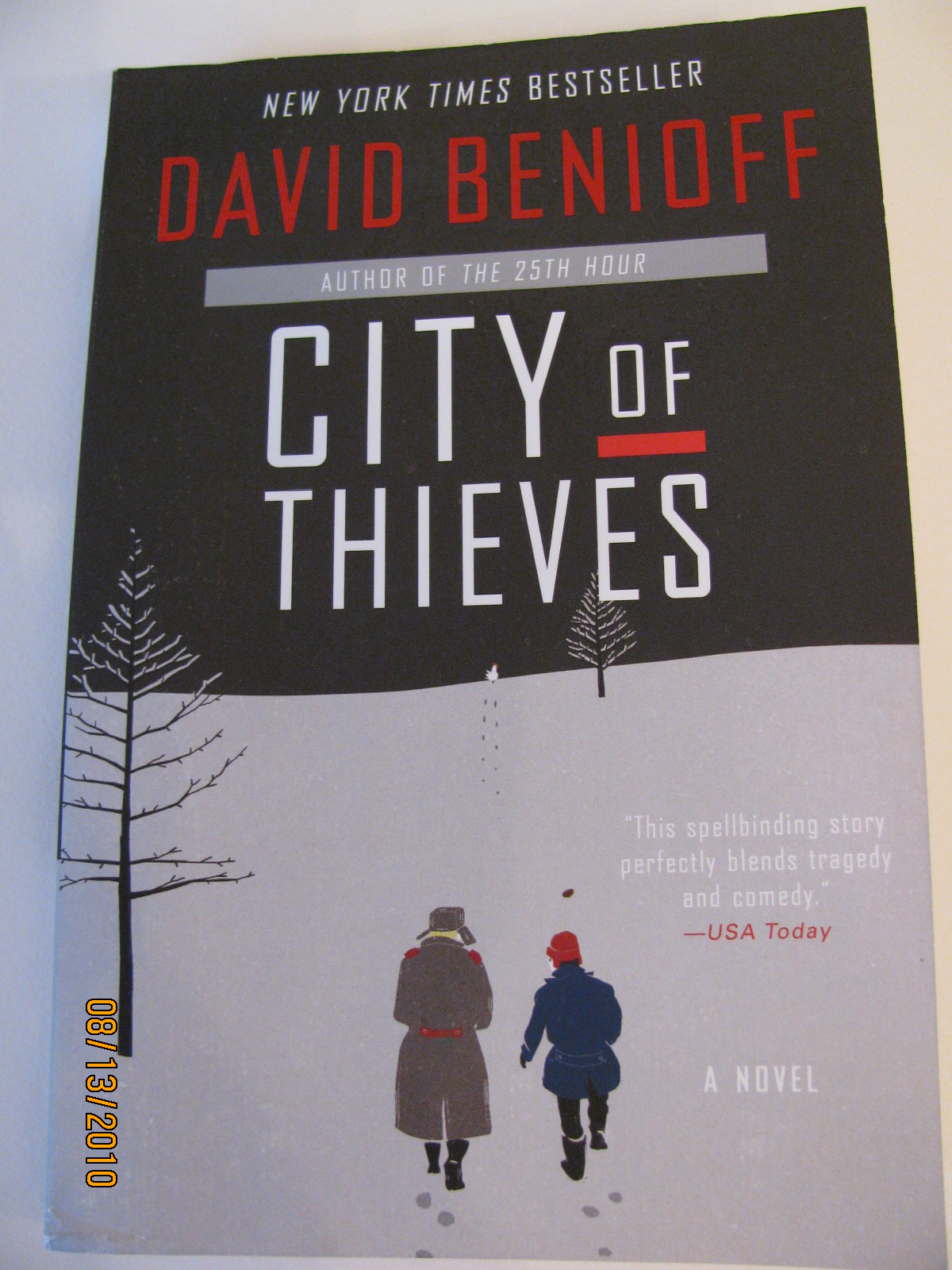
City of Thieves by David Benioff

At only 258 pages, this is a great, quick read for both men and women alike.  Set during the siege of Leningrad in 1942, this story revolves mainly around two young men, boys really.  Lev is Jewish and so his existence is precarious at best.  Kolya is blond, blue-eyed, with handsome Cossack features.  Where Lev is introverted and shy, Kolya oozes confidence, and charms everyone around him. 

Lev's father (a famous poet) has been "taken" by the secret police, and his mother and sister have fled the city.  Like most teenage boys, Lev proudly stays behind to defend his home, and is the commander of his apartment building's volunteer fire brigade.   One night on the roof, Lev and his friends see a downed paratrooper and rush to ransack the body.  You see, they are all starving.  Cannibalism is rampant (a true historical fact) and they are tearing apart books to boil down the bindings to eat the animal proteins in the glue.  This confection is called "Library Candy" and it's hard to come by and very expensive.  There are no dogs and cats left in the city.  Lev is caught looting the paratrooper's body, and sent to a formidable and infamous prison known as The Crosses.  There he meets Kolya, and the next morning, they are dragged before a high-ranking military officer who tells them they can go free on one condition.  They must somehow procure one dozen eggs, to be used in a wedding cake for the Colonel's beautiful daughter.  How they go about getting one dozen fragile eggs in the middle of a war, in the dead of a brutal Russian winter is the event-filled story.  This author was a student of Ann Patchett (Bel Canto) and he also wrote the screenplay for the movie The Kite Runner.  To write this book, David Benioff relied heavily on the personal diaries and journals of those who survived the actual siege, and historical books written about same.   The Nine Hundred Days by Harrison Salisbury was his bible as he wrote.  With the somber subject matter, I thought this would be a hard book to get through, but it wasn't.  It's not a long book and there are little moments of levity in among the harrowing circumstances.  A really interesting read.

Thursday, August 5, 2010

The Lonely Polygamist by Brady Udall

OK, this is the book of the summer for me.  It might even turn out to be the book of the year for me.  The author has ancestral ties to the old Mormon church in Utah, and maybe that's how he's been able to make it seem as if you're really stepping into that world behind the walls of a large polygamist family compound.  In an earlier post I reviewed the book The Nineteenth Wife  by  David Ebershoff.  Whereas the modern-day portion of that book was set mostly outside the grounds of the Mormon church and its family compounds, this one is right smack dab in the middle of it.  We have our main character Golden Richards; an innocent, bumbling hulk of a man who is overwhelmed by his four wives and his 28 children, and all the bills they come with.  Every character is finely etched, right down to Cooter the bug-eyed dog, and four-year-old Ferris who revels in running around with no pants on with all the joy of an escaped convict.  There's one wife, Trish, who is a bit more in focus than the others, and we see a lot of the Richards family through her eyes.  And then there's Rusty, the young boy who gives us an entirely different view of this cloistered world.   In The Nineteenth Wife, we saw more of the darker side of plural marriage, the Lost Boys, etc.  In this book, we see a lighter side, in that the many members of the Richards family are all good people at heart.  But, when you have that many children and wives, how can everyone feel validated?  That is the question.  And what are the consequences?  To find that out, you'll have to dive into this story.  And to entice you a bit further, there are a lot of funny and poignant moments in this book.  I couldn't put it down.

Sunday, August 1, 2010

Half Of A Yellow Sun by Chimamanda Ngozi Adichie

This is the 2nd book by this author that I have read.  I have to say that, for me, this one blows her other book (Purple Hibiscus) out of the water.   And her other book was good.  So, if this book doesn't earn Adichie a coveted place in the hearts of the Nigerian People, I don't know what could.  It's just GOT to be a beloved classic for them, although only just published in 2007.  Whereas Purple Hibiscus felt very contained (which was entirely appropriate for the subject matter), this book makes you feel as though everyone in it is in danger of floating free of their physical moorings.  Set in the 1960s at the cusp of a bloody civil war that will hopefully birth the strong new nation of Biafra, this book is expansive and brilliant and Shakespearean, and based on history.  The main gist is that the Igbo people secede publicly amid rampant government corruption.  As always, the manipulative forces of Colonialism and foreign interests in the oil-rich nation are working behind the scenes.  These forces that could have been used for good, end up, as they most often do, costing a lot of innocent lives in the interest of greed.  With all of these government entities and armies, you would think that this book would be a bit cold, a bit dry.  But to the contrary, it's very, very intimate.  Many of the village people are good, desperately poor and naive, and want to believe that their government will come through for them finally.  They rally to the cause armed with only their ideals and the hope of a better life.  Our main characters, many of whom are Igbo,  are so fully developed that they seem real.  We have two Igbo sisters, Olanna and Kainene, and their men, and the houseboy, Ugwu.  Time and place are vividly brought to life, including a few Ex Pats and lots of locals, but the two characters who really become fully alive are beautiful Olanna and the innocent houseboy Ugwu.  They grow and develop along with the story, which will land you in the villages, in the towns, in the ragtag Biafran army where they have carved rifles out of wood, in the kitchens where Jolof rice is prepared, in the side yard where the butterflies flit, and in the back hall where Olanna's future mother in-law is literally using tribal witchcraft against her.  Whereas the first book was just dark for me, this book also has a lot of hope and light in it.  A lot of ideals and resourcefulness and things to admire.  This was a great history lesson for me too.  I had heard of the country of Biafra before, but if you had asked me to tell you where it was, I would not have known, and would have replied, "Somewhere in Africa."  Now I could never forget!

Saturday, July 24, 2010

The Hunger Games by Suzanne Collins

A really fun page turner.  Don't let the fact that this book is classified as for Grades 7 and Up and Young Adult turn you off.  Big in the UK, this trilogy also has many fans in the U.S., such as Stephen King (who called it addictive) and Stephenie Meyer (who said she was obsessed with it).  If modern pop culture is any indication, it seems we are slightly obsessed with post-apocalyptic society; with books and movies such as The Road by Cormac McCarthy and The Book of EliAn older novel on the subject is The World Ends in Hickory Hollow   by  Ardath Mayhar.  So, back to The Hunger Games by  Suzanne CollinsLionsgate has bought the movie rights and the third book in the trilogy will be released on August 24, 2010.  I've only read the first book, but will probably read the other two.  I'm really glad I did not read any reviews before reading this book, because then as I read, the details were more surprising than I anticipated.  Spoiler Alert:  I WOULD STOP READING HERE IF YOU ARE GOING TO READ THIS BOOK.  In a nutshell, The Capitol is an evil monopoly who takes children from the outer districts and throws them into a HUGE high-tech arena and makes them fight for their lives.  The last one standing is the victor.  To make it doubly vicious, there are two kids from each district, so it's quite possible that some will have to kill their own friend or neighbor.  Whereas the outer districts are fraught with hunger and starvation, the Capitol will remind you of the wealthy Roman Empire who watched the gladiators with blood lust for sport.  I won't tell you any more, because even the smaller details are surprising and entertaining in the book.  Here's the official web site.

Sunday, July 18, 2010

The Thousand Autumns of Jacob de Zoet by David Mitchell

This is kind of a hot new book right now, and I was intrigued by the reviews on amazon.com.  I listened to a free library download, so don't have a good photo.  I do see on amazon, however, that there are illustrations inside this book that really add to the character of the hard cover.  Beginning in 1799, on a tiny island in Nagasaki Harbor, we meet our main character Jacob (pronounced yak-ob).  He seems to be a mid-level clerk in the Dutch navy.  Young, red-haired and freckled with green eyes, he's quite the oddity among both the Japanese citizens and the salty older sailors all around him.  If you enjoyed the book Shogun  by James Clavell back in the 1970's, you will probably like this one too.  To me, it's a shorter, lighter version of that theme, complete with the evil Lord, the lovely young Japanese midwife, and a cast of other characters.  It's really a fun armchair adventure, with colorful observations of the time, and a poignant ending.

The Season of Second Chances by Diane Meier

This is a fun read that will appeal to many women.  As the title suggests, our protagonist Joy Harkness is starting a new life, in Amherst, Massachusetts.  Joy is a loner, an accomplished college professor of a certain age who moves to a new town, buys an old wreck of a Victorian house, and begins to slowly open up her life and heart.  There is a Dickinsonian air about Joy, in that she is a  poetess who holds herself aloof from others, but that begins to change in myriad ways.  Enter Teddy, a genius remodeling contractor who begins to transform Joy's old house into a lovely home.  The author, Diane Meier, is a style guru, and the colorful descriptions of the home's new decor sprinkled throughout will make any woman's heart go pitter pat.  Don't we all want someone to come in and fix things for us?  Of course, the more people Joy lets into her life, the more complicated her life becomes, and therein lies the story.  Not an overly deep book, but funny and smart, and not prissy--this really is a good read that kept me turning pages when I should have been asleep.

Saturday, July 10, 2010

Cutting for Stone by Abraham Verghese

Reviews for this book on amazon.com are great.  It's a longer book at about 700 pages.  But, I'm convinced this is a modern-day classic, right up there with The Poisonwood Bible, etc.   Perhaps it is the author's own multi-cultural background that makes this book so real.  At the same time, there are faint hints of spirituality infused by the varying religions and beliefs of the characters.  The author Abraham Verghese is of Indian descent, but was raised in Ethiopia.  He previously wrote a memoir about his time as a doctor in Eastern Tennessee during the early years of the AIDS epidemic when there were very little resources for treatment.  He's a professor of medicine at Stanford, and also has a masters in fine arts and went to the Iowa Writers Workshop.  And all these disparate parts of him come to bear in this epic novel that begins in a mission hospital in Addis Ababa, staffed by Indian doctors, indispensable locals, and formidable nuns.  Born into this environment are twins; Marion and Shiva, who although almost one body and soul, are also very different.  Marion is the main voice and you will strongly identify with him.  Shiva is akin to his namesake, a bit mystical, a dancer, with a mark on his head.  Shiva is seemingly a bit aloof but all compassion when need arises.  As you read this book, you'll be swirled along through decades and political regimes, and lots and lots of medical procedures.  You see, Ghosh and Hema, the two Indian doctors who are the lifeblood of this microcosm, are doctors who rise to every occasion, and teach as they go, because they must.  Resources are so low, that Ghosh must teach another doctor how to do vasectomies, so he can have his own done.  I am not fond of surgery, or blood or sickness, and that speaks to the power of this book to keep me reading.  In this volatile country, Missing Hospital becomes an oasis of family and love, a lifeboat that many cling to.  No one element is overdone, in my opinion.  The third-world airline flights, the clinical rigor of medical school, , it all became so vivid.  I learned a lot of history along the way too.  Who knew that Eritrea had such Italian influence, or that Haile Selassie was such a small man?  I listened to this book through a free library download and the slightly clipped British/Indian accents really made it come alive.   I kept thinking that if I were medically inclined, this would be even better, but it didn't detract from the book for me, as the teachings were often sprinkled with humor.   A great gift for anyone medically inclined, and an amazing tour de force for this author.